A Vision Quest along the “Hippie Trail” finding Art as a Healing Way


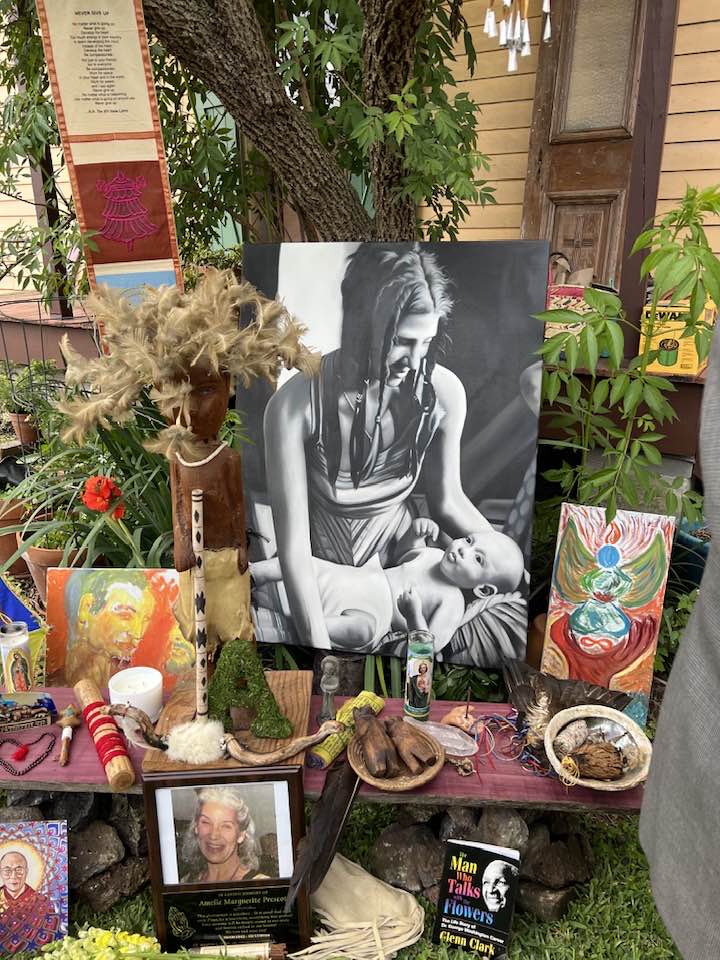
I first heard about Amelie long before I met her. She was described as “spiritual,” and a great teacher, mother, and grandmother. I heard it said that when a child acted out, she listened and went deep into what was going on for them. She didn’t punish, or ignore, but treated children with respect, like they were grown and wise spirits living in little bodies.
I had no idea when I interviewed her that before I finished this article she would have left the earth. Her children have been kind enough to allow me to tell this small part of her larger story.
Amelie was born in 1942, descended from the Louisiana Settlers, which includes indigenous native American blood, African blood, and French blood, often called Creole heritage. In the interest in brevity, let’s just summarize her early life as being raised by a “good family” in New Orleans, and getting swept up in the 60s, coming out to California, falling madly in love, sometimes with the same person, living with “sister artists who also had kids,” in Sausalito on houseboats with her partner, hanging out with Eric Clapton and other bigwigs of the day, and becoming a teacher, and then an art teacher.
New Orleans Roots – A Teacher at Heart
Amelie was a world traveler, whisked away across mountains and seas by her own inner will. She had had trouble getting work as a teacher, even though she was credentialed and qualified.
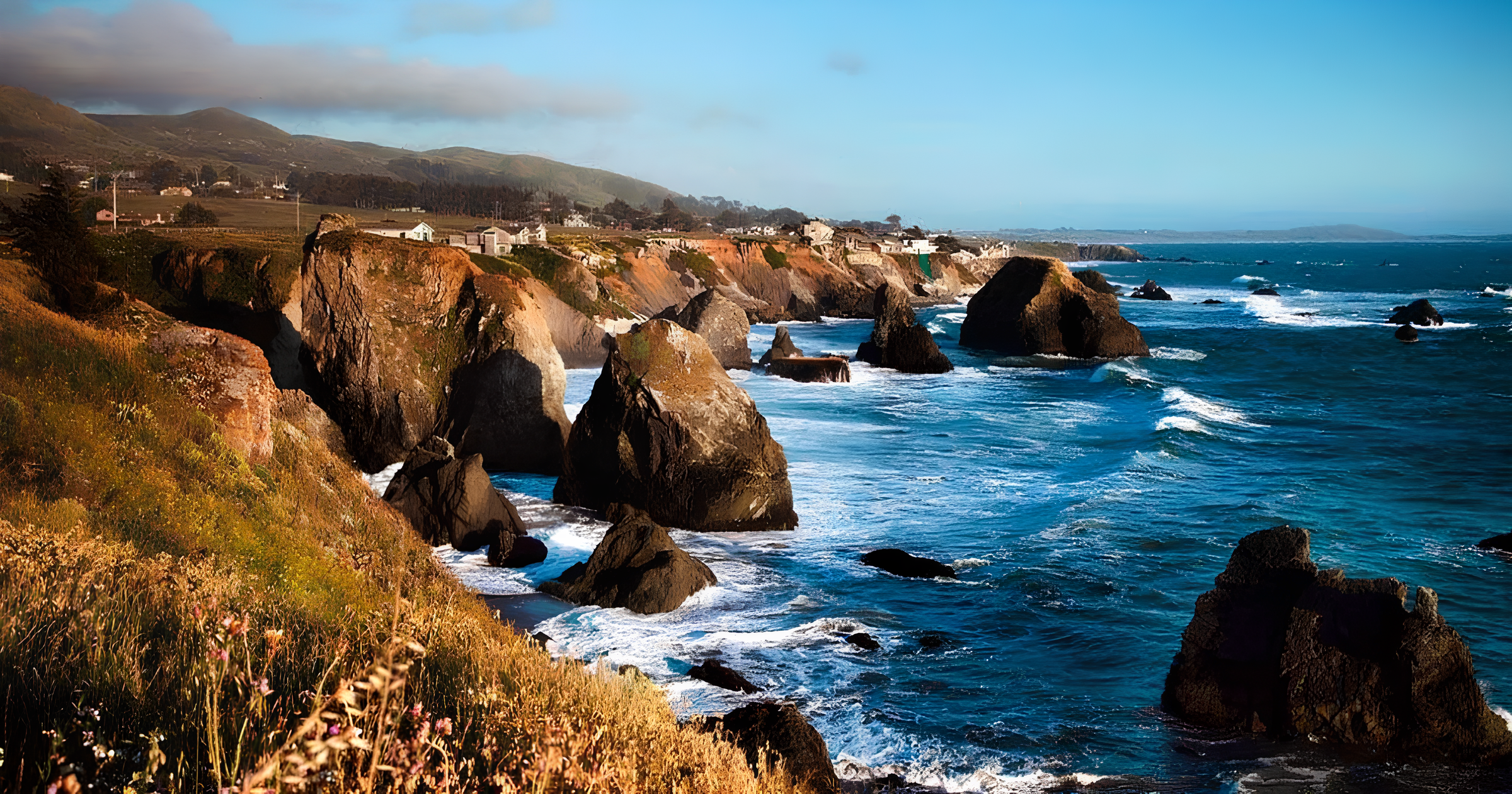
Amelie pressed on and eventually landed work teaching in Marin County. She was great with the kids, and even more so with the kids that didn’t necessarily take to the other teachers. After some time, word got out and she was asked to come to the coast to work with the Pomo children in Mendocino, who “didn’t want to go to school.” Amelie approached all children with compassion, as a storyteller and a listener. This helped her connect where trust wasn’t easy to come by between students and educational institutions.
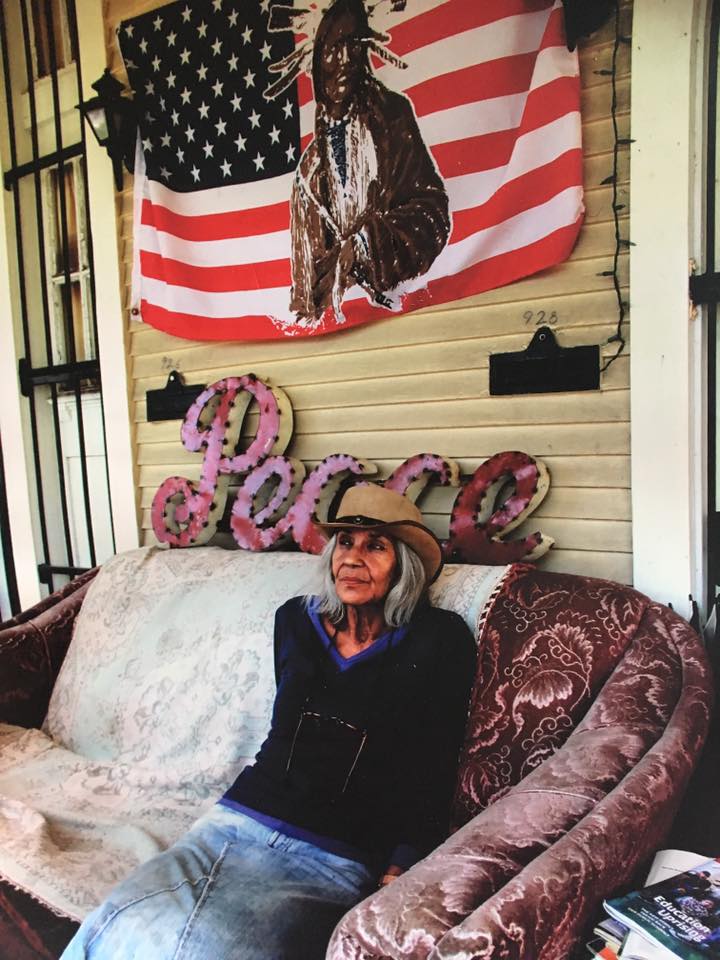
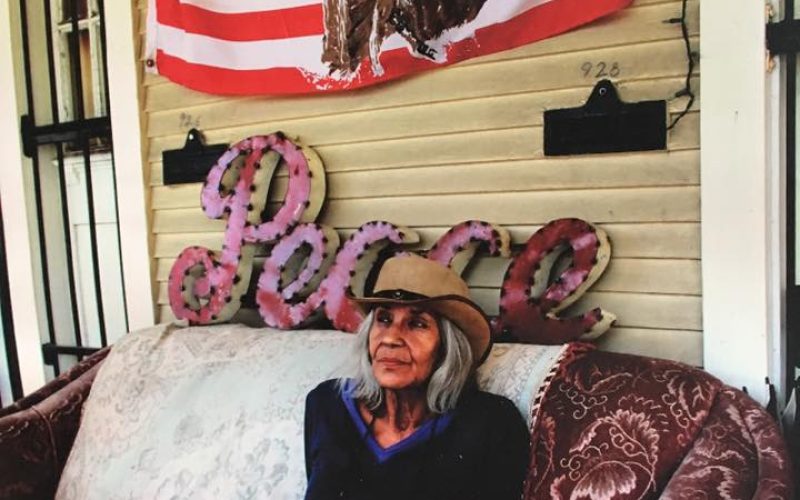
We talked for hours about her life, travels, and philosophies. Her strength and poise shone through, as did her immense beauty. Some artists make beauty, some personify it. Amelie with her piercing tone, natural wiry strength and lithe regal appearance had what is often called “a way about her.”
She told me, at 80 years old, that people stopped her on the streets of New Orleans, where she lived out the last decade of her life, to exclaim that she is “beautiful.” She believed this was because “I look like their ancestors.” A humble interpretation.
The stories of her travels came out in nonlinear tangents and spirals, of interlocking tales with recurring characters. She married a Swiss man, but left him behind in American when she took off for Europe. There she met a circus strongman who accompanied her during a part of her five-year journey… and so it went.
Walking the Hippie Trail Overland
London to Istanbul to Iran, Afghanistan, India
Amelie walked overland on what later became dubbed “the hippie trail” where she traveled by land and boat from London, through southern Europe to Istanbul, Turkey, then onto Iran, Afghanistan, eventually landing in Goa, India.
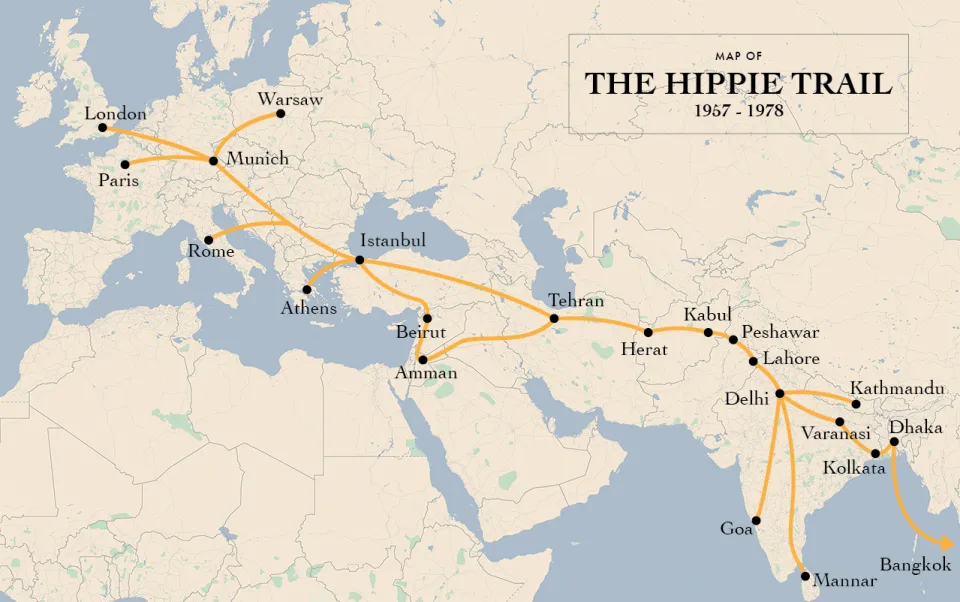
She was determined to walk across the Himalayas, which took many people, and a guide. When they started out the trek there were six of them, several fell off, but Amelie was determined.
Working as a Stuntgirl in Bollywood
Eventually she made her way to India and found work in Bollywood. She had fun working as a stunt girl in Bollywood movies. “They’d have me dive into the pool in the place of the movie star. After about five dives, I’d get tired.” Culturally Amelie didn’t have restrictions or shame… “they put me in the bikini cause the star couldn’t do that.

Every few weeks, she’d work in Bollywood pictures, and then go to Goa and live in a little Wickiup in a unique village. She explained you could “only get there by ferry.” Every few weeks, “I’d save my money and go down there for a few weeks… That went on for about a year.”
Amelie was reunited with a dear friend from back home in the streets of Bombay.” She said, “Where is the club? Where is the dancing?” Coming out of San Francisco in the 60s, they wanted to know “where’s the disco?” Amelie had previously met this woman in Bombay who wanted to make a disco, who had her “own money” and decided to create a disco in the Taj Mahal hotel in Bombay. She hired Amelie and her friend to design it. “I was an art student so I knew how to do the design and perspectives.”
Nepal ~ Teaching, Painting, Trekking
In exchange for their design work, they received tickets to Nepal. We went to Nepal and my second husband and I got married at the big Gompa at Swayambhunath. Amelie would sit on the steps and watch the devoted pilgrims walk in. “I’d go sit in meditation with them in the halls,” which led to her studying thangka painting. Eventually, she got a visa and a job teaching English.
“That’s why my husband married me – for a visa. We went up there and got married. They figured out our astrology… it [the wedding] was very serious… we had this amazing ceremony that went on for hours.”
She “enjoyed everything.” While living in swayambhunath, Amelie worked in Kathmandu. “I had to walk five miles barefoot every day, past burning gods, to get to my job teaching English.” She added, “I kind of liked it.” The students were young men who were preparing to go to university in the USA. After work, she’d walk home barefoot, through the rice paddies.
Walking Across the Himalayas
The Less Travelled Northeast Route
After a year, she decided she didn’t want to work anymore, and her visa ran out. “There were a bunch of us living together whose visas who had run out. Eleven of us who walked out of Nepal. Only three of us made it.
“I was completely unprepared for the Himalayas. It was supposed to take us 15 days to get to Darjeeling, it took us three months…We wanted to go a particular route, the northeast route, that no one had taken in 20 years. I was running the show, said ‘I don’t wanna do this. I wanna do that.””
Amelie recalled Wong De Sherpa, a spiritual teacher she encountered in the Himalayas. “I learned my buddhism from him. He said take off your shoes and walk in my footprints. We went to a special village, the village of the llamas, with mating cows and yaks so they could live below eight thousand feet. We’re at this village and we are waiting for Wong de Sherpa to come out.” The wait turned out to be worth it.
“The holy man looked at me and said, “What are you doing here? You should be back teaching the native ways to your people. Those are the ways that will save them.”
In a long arduous journey there are moments that make it worthwhile, where in the spiritual quest, one finds the kernel of wisdom, the holy grail they’ve been looking for. This was one of those moments.
“Finally we got into Darjeeling… I got lice in my hair and had to hire a girl to help me. Should’ve just shaved my head. I was very skinny, and hadn’t had much to eat in months. We went down to Calcutta.” Suddenly Amelie was in the middle of a big city. “People slept in shifts there, there were so many homeless. Some sleep at night, and others sleep during the day. We took the train to Bombay again.”
The Buddhas of Bamiyan, Afghanistan
Amelie wanted to go to Afghanistan, to see the valley of the Buddhas and the Bamiyan temples.
Amelie travelled with no previous knowledge of the places she was headed to in many cases, beyond what she’d seen in history or art books. This was before the internet, before Lonely Planet.
At that time, to go to Afghanistan as a woman, you needed to go with a man, and that man had to be willing to carry a gun.
“I went to a cafe in Bombay and found this muscled Irish guy and said “I’m looking for someone to take me to Bamiyan. This tough fellow agreed without hesitation. His name was Anthony. He was a lion tamer. “
Then she smiled and said, “Doesn’t every girl want to run away with a lion tamer?”
She described their journey to Bamiyan, which had been sparked by a photo she saw in an art book back in the states during her studies. She went into Afghanistan riding on top of the bus with the luggage, and arriving without a dime in her pocket.
Penniless to Fine Dining with Bertolucci
In Afghanistan, Amelie saw an advertisement for movie extras needed for the Italian filmmaker Bertolucci. “They chose me!”
Next thing she knows, Amelie is in fanciest room in the fanciest hotel in the region, filming happening around her daily. “Every night there’s a big fancy Italian dinner. I made a lot of money.” With this influx, she was able to make her way to the Buddha’s heads, and she saw they had been defaced and thought to herself, “They’re not there anymore.”
She went overland in a VW bus back to Italy, stopped at every border, asking landowners for permission to pass, sitting and smoking hookah with them, sometimes waiting days until they allowed them to drive through.
Amelie and her Farsi-speaking companion Anthony got back to Italy and stayed on a boat off the coast of Rome. She’d caught a bad case of Hep A, was very skinny, and ended up in the hospital for over a month. “This is when I started learning about healing.” A good friend of hers had come to visit her weekly in the hospital. On the fourth week, she stated in exasperation, “Amelie, you’re not getting better. You need to get better or I’m not going to come visit you anymore.” Amelie wasn’t sure what to make of it at first, but it got her attention. She sat up in her bed and started focusing on running healing energy through her body, which seemed to be a turning point.
Her parents sent her money and she went home to the states, leaving her time with the circus painting sets, and Anthony behind.
Arriving back to the San Francisco Bay Area, one of her friends said, “Hey Amelie, wanna go out to Alcatraz island?” She hadn’t seen a paper in years and had no idea people were taking back the land. She went out and was a part of the movement.
18 Months in Bali ~ Communal Art
Art as an antidote to violence
Amelie’s first husband, Olaf, was Swedish. He suddenly inherited money and set out to Bali to set up a sound studio. She described him as an “electrical genius.” He asked her to come to Bali, and had Amelie buy all these special things which weighed over 2000 pounds. When Amelie arrived on the island, he’d been waiting for her there for a year and a half.
Amelie described that she didn’t “have any common culture’ with Olaf. She didn’t pay this much mind until she realized she was on a vision quest. “I’d never heard that term before. This was year five of traveling…” She trailed off thoughtfully. Once she understood what she was actually doing with all this traveling, she found a local shaman and asked him to be her guide.
He started every morning with tasks for me to do. Then there I am in Bali… Running all over the island. Studying art everywhere. I had gone on this journey and I realized I was looking for communities that were nonviolent to see how they educated their children. I hung out in the different villages, carved, made my art tools, and did art all the time.”
Before I let Amelie speak in her own words about Balinese culture, I’ll take a moment to note that it is difficult for any outsider to observe another culture with true clarity. The lens through which we look is convex, warped by our own assumptions and cultural upbringing. The hippie movement that Amelie was a part of can be defined partially as a group of people yearning for peace on earth. They passionately sought out experiences and understanding that would lead to inner and outer peace. Amelie’s physical travels were a part of her inner quest to make peace with herself and find her purpose.
From what Amelie saw during her time in Bali, she extrapolated that “there was never any violence, ever…Because EVERYBODY DID ART ALL THE TIME. That’s what they did with their energy all the time. Everybody was an artist. Not individual artists where people signed their names. The whole village would work on a painting together. The important thing was that the young artists were honored and respected and paid.”
Amelie continued fasting and visioning, each morning she’d go down to the beach and her vision would start where it left off the day before. After much deep reflection and receiving the guidance she’d been looking for, it was clear to her that her life’s work was changing the educational system.
She came back to the states and spent the next 50 years working in the schools, teaching and bringing art and indigenous healing ways to the children of California and New Orleans.


To find out more about her legacy and the work that continues on, visit:
Or read about her life here://obits.nola.com/us/obituaries/nola/name/amelie-prescott-obituary?id=49141756