Liana Casciani, Elk California


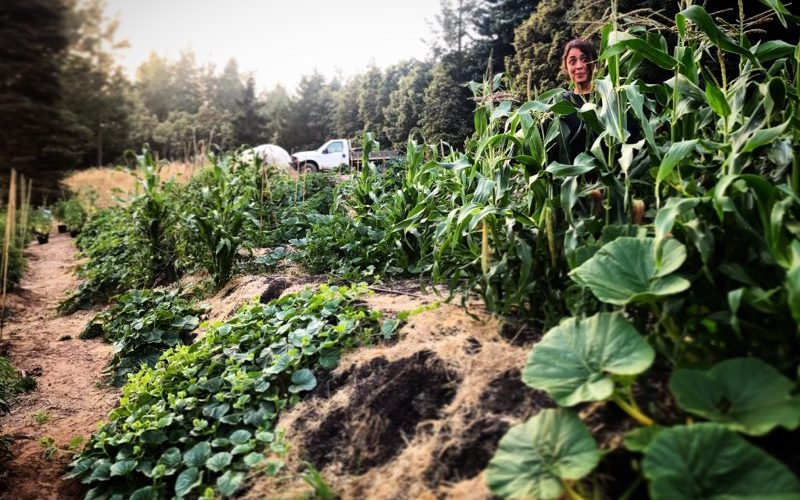
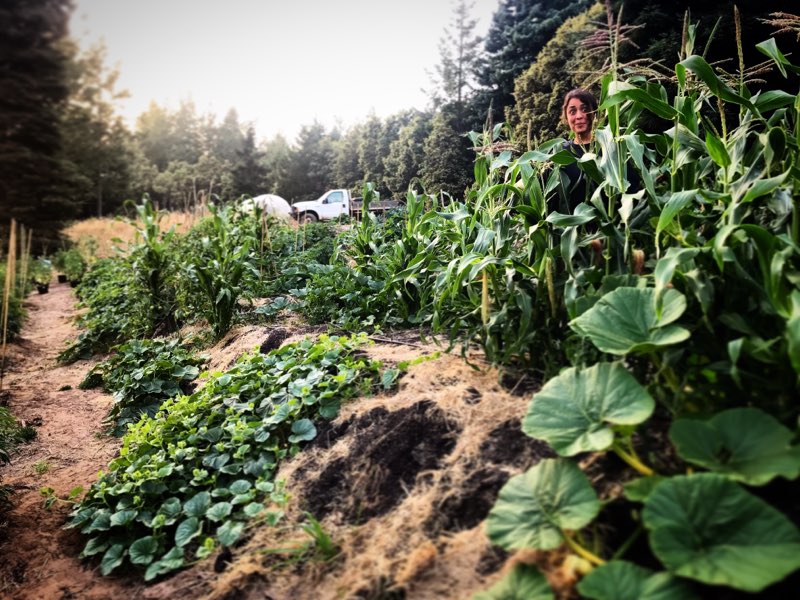
In a word, Liana is magnetic, larger than life. With a laugh that can fill a room, a steel-trap mind, and a work ethic to be revered, she has the life force required to have a full-time jobby job and grow a mountain of food each year. Two tons of food to be exact. She lives with her partner on a rural property in Elk where she saves seeds, trades with neighbors, and has an ongoing relationship with wildlife.
The first year on the land they had goats and chickens, but not a one made it through the spring. The mountain lion came for the goats while their 90lb guard dogs were off duty. The foxes have an uncanny way of breaking into the food pantry and carb binging, while the bear has not only gotten their beehives and stores of honey, it actually managed to spill over and drink a 55-gallon vat of homemade fertilizer.
She regales these stories with a sparkle in her eye, and a palpable joy and tenacity required to enjoy the ups and downs of altogether rural life. This positivity and hutzpah seeps into how she plants and what.
Born and raised in Rochester, New York, she made her way to California by way of Austin, Los Angeles, and San Francisco. In her own words:
My life is fully changed.
I came from an upper-middle-class – a very blessed and privileged life. I never really had to work as hard as you do when you live off the grid. I was raised with the “you work hard to live a comfortable life” mentality. I was supported in every endeavor, but it was ingrained in me to use my brain – not my body – professionally. That was passed down to me from my father. My father’s parents were farmers in Italy who wanted better for their children and immigrated to the states. I think I was pulled towards the farming life because it ties me to my ancestors. It connects me to my roots. I’m able to carry on the traditions I was taught as a young child and make my Nonni proud: canning tomatoes, red peppers, making homemade pesto, pickling eggplant, and jarring beets. Both sets of grandparents always grew a small garden, because the tomato & basil you grow always tastes better than the ones you buy.
On both sides of my lineage, my family immigrated from Italy & Sicily less than 3 generations ago. My family has worked so hard to give us a life where we wouldn’t have to. That was the norm for families who immigrated from Italy, to wish for “better lives” for their future generations. They took care of us, they still do, and I’m immensely grateful for that.
Perhaps what they didn’t know was that I’ve never felt more connected to my ancestors than I do now, living of the land.
They think: Why choose such a trying way of life?
My parents have said ‘We don’t get it but we’ve never seen you happier.’
They wouldn’t live this life, it’s not what they imagined for me, but they are super supportive and come visit us often to watch my partner and I grow and build our dream.
In all of my little apartments across the country and up the coast I always tried to grow things… balcony gardens with fresh herbs, etc. While the scale is different, it is not that astronomical to follow the dots. I have a love of food and growing it.”
Her partner began the garden in 2017. As far as deciding what to plant in the orchard, garden beds, or greenhouse, Liana doesn’t listen when people say, “you’re not going to be able to grow that in this area.” They put seeds in the ground and see what gives, ahem, grows.
In 2020 the majority of their crops were eaten by gophers and deer. It was a hard year all around, “we were able to feed ourselves but we didn’t have the abundance to share with our community in the way our hearts wanted, especially in that trying year.”
With all the ups and downs in this way of life, Liana mentions it is extremely helpful to have a positive partner. “I wouldn’t be here if it weren’t for him. He’s taught me a tremendous amount, from sharing knowledge and patience to then allowing me the independence to grow on my own. He’s truly one of a kind.”
Being first-time homesteaders, we have a “go big or go home” mentality.
Liana clarifies that she actually doesn’t consider herself a complete homesteader because she does buy some food items. 70-80 percent of her diet comes from the land, but not all. They have raised and slaughtered ducks for a local chef, have an active beehive and forage for edible mushrooms and other wild herbs. This is in addition to growing an amazing variety of vegetables. Notably, a plethora of squash varietals and banana melons, a delicious citrusy heirloom melon that is on the list of plants they were told “would not grow here,” but flourished.
When it comes to raising animals with wildlife all around, she describes a steep learning curve. “We started with goats and one of our big learning points was ‘you build a fence before you get goats, not the other way around.’ We lost our pregnant goat first. Female goats that are about to give birth will sometimes want to be isolated. (This goat was) doing that in the middle of the woods only days after arriving. The mountain lion is the biggest predator on the ridge, other than the bear. The mountain lion got our first goat. Our dogs found her skull and brought it back to us.”
They put up an electric fence around the three remaining Nubian Alpine goats, immediately after the first one died. “Goats are very smart animals. They learned to escape by watching my partner hop over the fence. They’d jump out over, and sometimes pull the fence down with them, getting their legs tangled up in the posts and wire. Their two 90lb dogs, Thelma and Louise, were sufficiently intimidating to the mountain lions that no goat was attacked when the dogs were around. The goats would run wild with the dogs and have no problems. In fact, they once ran all the way down to the highway! However, the goats did not always stay close to the dogs and another goat was lost to the mountain lion, and then another. Coco, the final surviving goat, was spooked. We can be fairly certain she was traumatized from seeing her friends get eaten. They decided to give Coco away to a nice farm inland because they couldn’t stand to see another one get killed. Lift your cup or light a candle in memoriam of the three goats lost: Henrietta, Harriet, and Vanilla.
I asked Liana about her favorite plant, thinking I’d be regaled with the details of a particular garden heirloom varietal, but she said her favorite plant isn’t one she grows.
She told me about a wild plant that grows all over the globe called stinging nettle (Urtica dioica). “Most people think it is a weed, but it is a superfood. It comes up in the spring and grows similar to basil. When you cut it, it splits in two and you can continue to harvest it if you are diligent.” She did warn that when it’s flowering there is a chemical that is bad for your kidneys. A tough cookie, she did not warn that this plant is covered in tiny stinging hairs. Each hair is like a hollow needle containing formic acid, which happens to be the compound in ant saliva that causes a sting. People often wear thick leather gloves when wildcrafting and put the plant directly into a bag they can close to avoid getting stung. Interestingly, in old Europe this same sting was used as a folk remedy for arthritis and stiff joints.
Once the nettle flowers, the plant can still be used, but as food for the garden instead of the humans. When it flowers, you can take the whole plant and ferment it and make it into high nitrogen fertilizer. “Nettle is super good for us and super good for the plants!” To make fertilizer, fill a 5-gallon bucket halfway with chopped-up plant matter, then fill the other half with water. Stir it every day. It should bubble within a week. Keep stirring every day, depending on heat and sun, in about three weeks it should be ready, strain it, dilute it and pour on the plants in the garden. It may be stinky, but it is highly fertile!
It’s worth noting that the bears like it. Liana was making a nettle fertilizer and then the bear knocked over the 55-gallon drum and drank it all. We all know bears also like honey. Several hives were taken by the mama bear, but they’ve had luck keeping a hive since they put it up on top of a metal horse trailer they converted into a chicken coop. Just as we bag food and string it up a tree to protect it from bears, so goes it with hives. So far, at least! Now back to nettle…
Nettle Pesto Recipe:
To get stinging hairs off of the leaves, blanch them for 45 seconds, then plunge them into an ice bath. After that, squeeze them until you are left with a green ball of plant matter. Nettle cooks down like spinach. To make into a pesto, use Parmigiano Reggiano, olive oil, salt, pepper, and a ton of garlic. Liana notes that pine nuts are too expensive these days so she recommends using cashews or walnuts instead. It is a favorite. “I’m lucky if it makes it to the end of the day!”
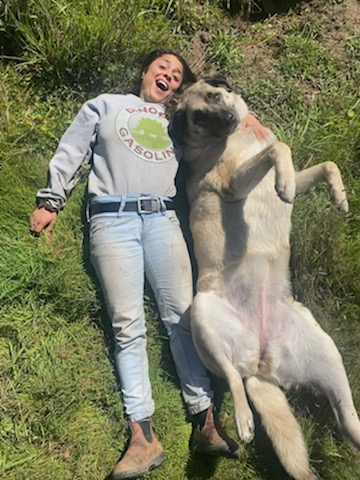
I asked her about her peak moment so far this year. She described adopting their new dog, Gaia. She’s a 9-year-old Anatolian Sheppard, weighing in at 155 lbs, “my own wolf-dog.”
“We were alone laying on the ground together under a full moon. She was facing the moon and her face lit up by the moonlight. We had had a hard couple of months, and I started weeping. I had one hand on Gaia, who is not cuddly or snuggly. I hadn’t cried really hard in a while and I needed to…one of those cries that’s a true weep. Gaia looked me in the eyes, tucked her head into my chest and hooked me in, and let me snuggle her while I cried.”
Liana can be reached via Instagram @LianaCash or email Liana.casciani@gmail.com